Showing posts with label environment. Show all posts

Thursday, June 5, 2025

Where is Donald Trump Headed in his Second Term?

Note: This essay was generated using ChatGPT. The following questions were put to the app:

1."What are the principal components of President Donald Trump's executive agenda, and what overall objective do those components apparently aim to achieve?"

2. "It seems to me that Trump's attack on institutions of higher education, illustrated most recently by his attempts to freeze funding for Harvard, and to eliminate Harvard's ability to enroll foreign students, is another component of his agenda."

To which the app responded:

You're absolutely right—and your observation pinpoints an increasingly prominent component of Trump’s second-term agenda: an ideologically driven campaign against institutions of higher education, particularly elite and research-oriented universities like Harvard. This campaign serves multiple functions within his broader authoritarian-nationalist strategy.

The response of ChatGPT to each question has been consolidated an reproduced below.

Part II, posted separately, will be an outline of what we, as private citizens, can do to thwart Trump's authoritarian agenda.
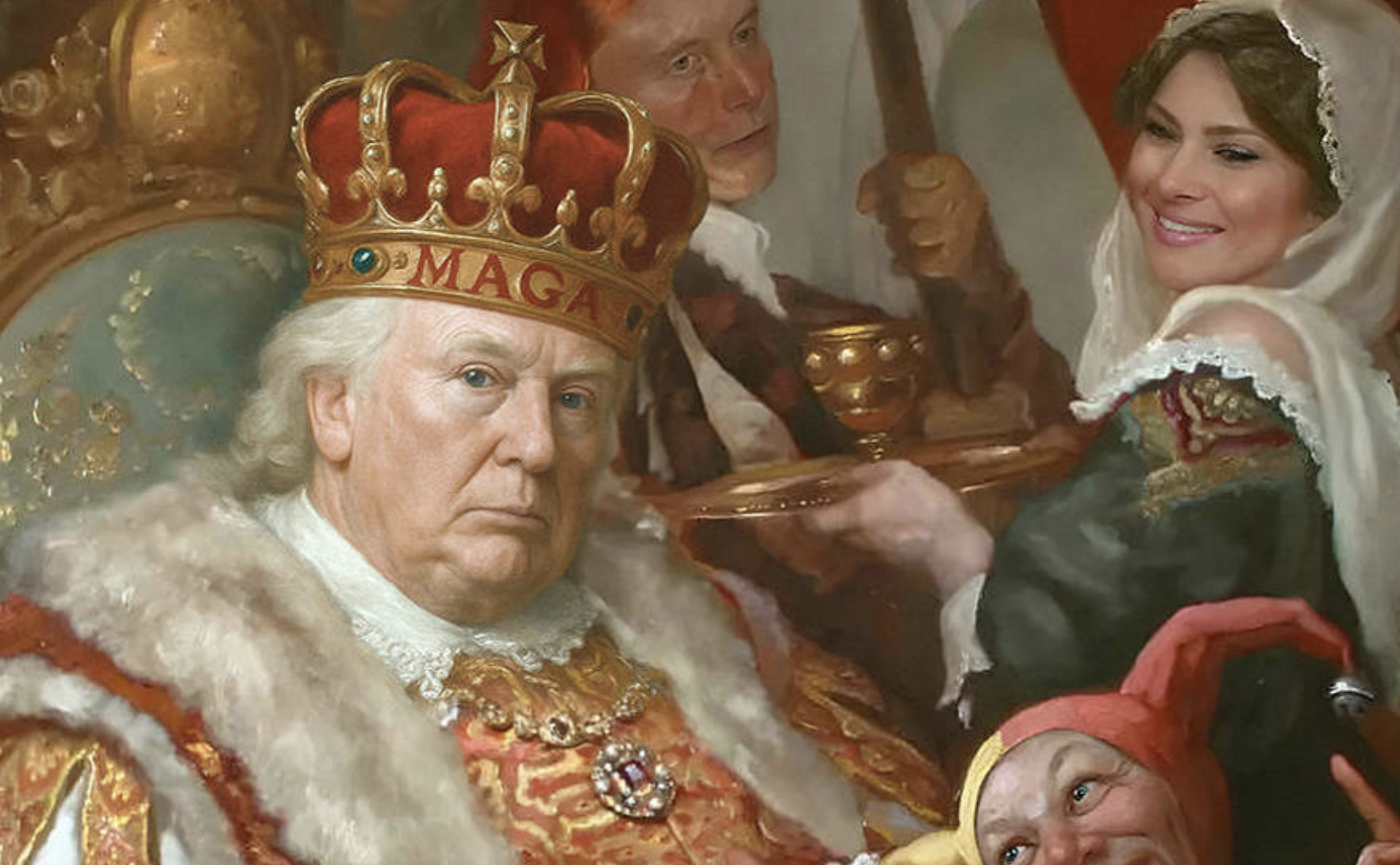
 

Artist's conception of Donald Trump in "King Trump vs. The Bond Market," by Kenneth Rogoff, in Project Syndicate, June 2, 2025.


President Donald Trump’s second-term executive agenda—based on public statements, policy actions, Executive/administrative orders, and aligned legislative efforts—revolves around a set of core themes that emphasize executive power, national sovereignty, economic nationalism, and a rollback of liberal democratic norms. These components appear to aim at consolidating presidential authority, remaking the federal bureaucracy in his image, and reshaping US governance and international posture according to his ideological framework.

Principal Components of Trump’s Executive Agenda (Second Term)

1. Expansion of Presidential Power

  • Emphasis on “unitary executive” theory: Trump and his legal advisors argue for nearly unchecked presidential control over the executive branch.

  • Claims of immunity: He asserts legal immunity from prosecution for actions taken while in office, with the Supreme Court taking up these questions.

  • Defiance of checks and balances: Trump has shown a willingness to ignore judicial rulings and marginalize congressional oversight, particularly regarding subpoenas, budget authority, and the administrative state.

2. Control and Purge of the Federal Bureaucracy

  • Reinstatement of Schedule F: Reclassifying civil service employees to allow for their dismissal and replacement with ideological loyalists.

  • Loyalty tests: Efforts to ensure government employees align with Trump’s agenda, including investigations into “deep state” influence.

  • Curtailment of independent agencies: Moves to bring agencies like the Department of Justice and the Federal Reserve under tighter presidential control.

3. Hardline Immigration and Border Policies

  • Mass deportations: Plans for large-scale removal of undocumented immigrants, including use of the National Guard.

  • Use of military for domestic enforcement: Expanding the role of federal and even military forces in policing the border and urban protests.

  • Asylum system rollback: Policies to deny or severely restrict refugee and asylum claims.

4. Retrenchment from International Institutions and Alliances

  • Threats to withdraw from NATO: Continuing efforts to reduce US commitments to collective defense structures.

  • America First foreign policy: Prioritizing bilateral deals over multilateral frameworks; reducing U.S. foreign aid and engagement.

  • Appeasement or realignment with authoritarian leaders: Favorable posture toward leaders like Putin and Orbán.

5. Rollback of Environmental and Regulatory Protections

  • Elimination of climate regulations: Withdrawal from international climate commitments and dismantling EPA authority.

  • Deregulation: Broad dismantling of financial, environmental, labor, and consumer protections under the guise of economic growth.

6. Weaponization of Federal Agencies Against Political Opponents

  • Justice Department investigations: Politicized investigations into Trump’s critics and adversaries.

  • Use of IRS, DHS, and other agencies: Allegations of using federal power to intimidate or punish perceived enemies.

7. Curtailment of Voting Rights and Electoral Oversight

  • Restricting mail-in and early voting: Advocating for measures that limit access to the ballot.

  • Challenging electoral legitimacy: Continued refusal to accept past results and groundwork to undermine future electoral outcomes.

8.  Delegitimizing and Defunding Higher Education Institutions*

  • Suppress Dissent and Intellectual Independence:
  1. Universities have historically been sources of resistance to authoritarianism, offering platforms for critical thinking, research, protest, and investigative journalism.
  2. Weakening these institutions undermines a major check on government overreach and narrows the space for ideological pluralism.
  • Undermine Meritocratic Elites and Reshape the Knowledge Economy:
  1. Trump’s broader populist narrative hinges on attacking “elites” and replacing professional expertise with loyalty and ideology.
  2. By degrading the authority of academic institutions, Trump delegitimizes the scientific, legal, and journalistic communities that challenge his claims.
  • Cultural engineering:
  1. The university is one of the last bastions of multiculturalism, globalism, and critical inquiry—all targets of the “America First” worldview.
  2. Attacks on DEI programs, gender studies, climate science, and global partnerships aim to reorient education toward a narrow, state-aligned ideology.
  • Appeal to Authoritarian Voters:
  1. For Trump’s base, especially white evangelical and ultranationalist voters, these attacks resonate deeply as a defense of “traditional values” against cosmopolitanism and liberal secularism.
  2. It’s not just about policy—it’s a symbolic assault on a class and culture they resent.
_________________________
*Like attacks on the press or the judiciary, these efforts to control or silence universities follow a familiar pattern from autocratic regimes—think of Hungary under Orbán, or Turkey under Erdoğan—where academic independence is crushed as a threat to national unity.

Overall Objective: Autocratic Executive Realignment

These components point toward a systematic restructuring of American governance to concentrate power in the executive branch, erode democratic guardrails, and transform the presidency into a more authoritarian institution. The assault on higher education complements his attacks on the judiciary, media, civil service, and voting systems—each a pillar of a constitutional democracy that resists authoritarian consolidation.
 
This is often framed by Trump and his allies as a restoration of American greatness and sovereignty, but operationally it resembles an effort to:
  • Undermine institutional checks on the presidency (courts, Congress, civil service, education)

  • Reorient loyalty from the Constitution to the president personally ("Re-educate" the populace)

  • Reinforce a nationalist-populist ideology hostile to globalism, immigration, and pluralism

  • Secure long-term political dominance by altering the administrative and electoral infrastructure

In essence, Trump’s agenda aims not just to govern differently, but to change the nature of governance itself, shifting the US toward an executive-centered regime with fewer constraints, less transparency, and a more exclusionary vision of national identity.


Monday, May 1, 2017

Only Two Weeks Left

"Every echo system performs 'services' that maintain the conditions necessary for all life. Forests store and pump out vast quantities of water, thereby modulating weather and climate; they remove carbon dioxide from the air and generate oxygen by photosynthesis; they inhibit erosion; and they provide essential habitat to countless other species. Such 'echosystem services' are priceless: they keep the plenty healthy." (David Suzuki, The Legacy, 2010)

An article in "The Hill," points out that the Environmental Protection Agency (EPA) is looking for all those dreaded "onerous and burdensome" regulations, especially Obama-era regulations, to repeal.
A regulatory reform task force, established by President Trump’s Feb. 24 Executive Order 13777, is seeking public input on which rules to roll back, the agency said Wednesday in the Federal Register.
The task force is also working with program heads inside the agency to identify rules that they believe impede job growth and impose more costs than benefits, according to The Hill. Republicans are, of course, speaking to the costs levied on their big business campaign donors, and the negligible benefits of preserving a livable planet.
The task force will take this information into consideration before it recommends to EPA Administrator Scott Pruitt which rules to repeal. Pruitt, who denies CO2 has promoted global warming, blamed the Obama administration for “abusing the regulatory process to advance an ideological agenda.” Presumably, Obama's ideology was to prevent wholesale destruction of the biota.
“We are supporting the restoration of America’s economy through extensive reviews of the misaligned regulatory actions from the past administration,” Pruitt said in a statement.
“Moving forward, EPA will be listening to those directly impacted by regulations, and learning ways we can work together with our state and local partners, to ensure that we can provide clean air, land, and water to Americans,” he added.
Frankly, I don't believe that Denier Pruitt gives a hoot what you, the general public think about the regulatory rollback. And whatever regulations are left in place will be hard to enforce with a looming 31% cut to EPA funding. Nevertheless, if one doesn't comment, Scott Pruitt will sleep soundly thinking the public doesn't really care about what kind of shithole we leave to future generations.
So go to the EPA comment page here, read the memo containing the criteria for identifying "repealable" regulations, then click the "Comment Now" button in the upper right corner, and make your input. You have until May 15, 2017, to do so -- because Administrator Pruitt thought one month (he posted his memo April 13th) was plenty of time to allow the public to comment on his dismantling of environmental protections.

Two weeks from now.

Do it now!

Wednesday, January 25, 2017

A Note From Lora Rathbone Suggesting Actions We Can Take Now

Hi Everyone;

Here are some issues that need attention this week. Since it’s early in the process, it may be best to just ask for support on the issue rather than give bill numbers. The easiest thing to do is to call the legislative hotline: let them know your name and address, and they’ll forward the message to our legislators. Call: 1-800-562-600

For more info, go to www.legwa.gov  and www.fanwa.org


Voting Rights/Campaign Financing
Several bills will be heard this Wednesday. TODAY.  While we see greater public concern for the influence of big money special interests on politics, we also see those same interests taking advantage of loopholes in the law to not only contribute massive sums of money, but to do so without any public disclosure. Allowing this massive flow of "dark money" presents a serious threat to our democracy. Your legislators have an opportunity to do something to stop that flow by passing the Washington State DISCLOSE Act (SB5219), and SB5108 to shine light on contributions between political committees. (LWV WA)

Gun Safety
HB 1134 and (SB 5050) ban the sale of military-style assault weapons and to limit the size of ammunition clips. Access to assault weapons in Washington is problematic and has resulted in tragic mass shootings in Washington and the US. As assault weapons are considered a long gun for hunting, they can be legally purchased by persons as young as 18 and released to the buyer immediately after a simple background check. Pistols on the other hand require training, an extensive background check by law enforcement meaning a waiting period of around ten days normally, and a minimum age of 21. (LWV WA)

Environment
HB1048  It extends renewable energy tax incentives through 2021; increases low income individual participation in renewable energy programs; requires solar module recycling or “take back.”

HB1233 Aligns utility revenue incentives with the current need to conserve energy in order to reduce carbon emissions.

Dakota Access Project
You can find all 17 banks supporting the Dakota Access Project and their contact information in this YES! Magazine article: http://bit.ly/2ddtWGe. In order to get this link to work, you need to click on it and another line will appear underneath. It should put you through to the article by double clicking on that. If you should happen to contact US Bank, the person whose name I was given by my local bank is Dana Ripley. Haven't been able to get through yet. Here's what the Oceti Sakowin youth advise for a possible script:

“As a customer of [bank name] I was upset to learn that you are financially invested in the Dakota Access Pipeline, which threatens the water and livelihood of the Standing Rock Sioux and the thousands of people who live along the Missouri River. I’m calling to ask that you withdraw your financial support of and stake in the project immediately.”

LaDonna said the Oceti Sakowin camp will be closing in February, leaving Sacred Stone, her camp, and Rosebud + a new one will be locating right in Cannonball. I don't know truly how many camps there have been. Some are certainly continuing to hang in there. Wanted to let you know there's a web site for Sacred Stone. It's sacredstonecamp.org. Donations to that camp can be sent to Sacred Stone Camp, PO Box 1011, Ft. Yates ND 58538.

Thanks,

Lora