Showing posts with label authoritarian. Show all posts

Thursday, June 5, 2025

Where is Donald Trump Headed in his Second Term?

Note: This essay was generated using ChatGPT. The following questions were put to the app:

1."What are the principal components of President Donald Trump's executive agenda, and what overall objective do those components apparently aim to achieve?"

2. "It seems to me that Trump's attack on institutions of higher education, illustrated most recently by his attempts to freeze funding for Harvard, and to eliminate Harvard's ability to enroll foreign students, is another component of his agenda."

To which the app responded:

You're absolutely right—and your observation pinpoints an increasingly prominent component of Trump’s second-term agenda: an ideologically driven campaign against institutions of higher education, particularly elite and research-oriented universities like Harvard. This campaign serves multiple functions within his broader authoritarian-nationalist strategy.

The response of ChatGPT to each question has been consolidated an reproduced below.

Part II, posted separately, will be an outline of what we, as private citizens, can do to thwart Trump's authoritarian agenda.
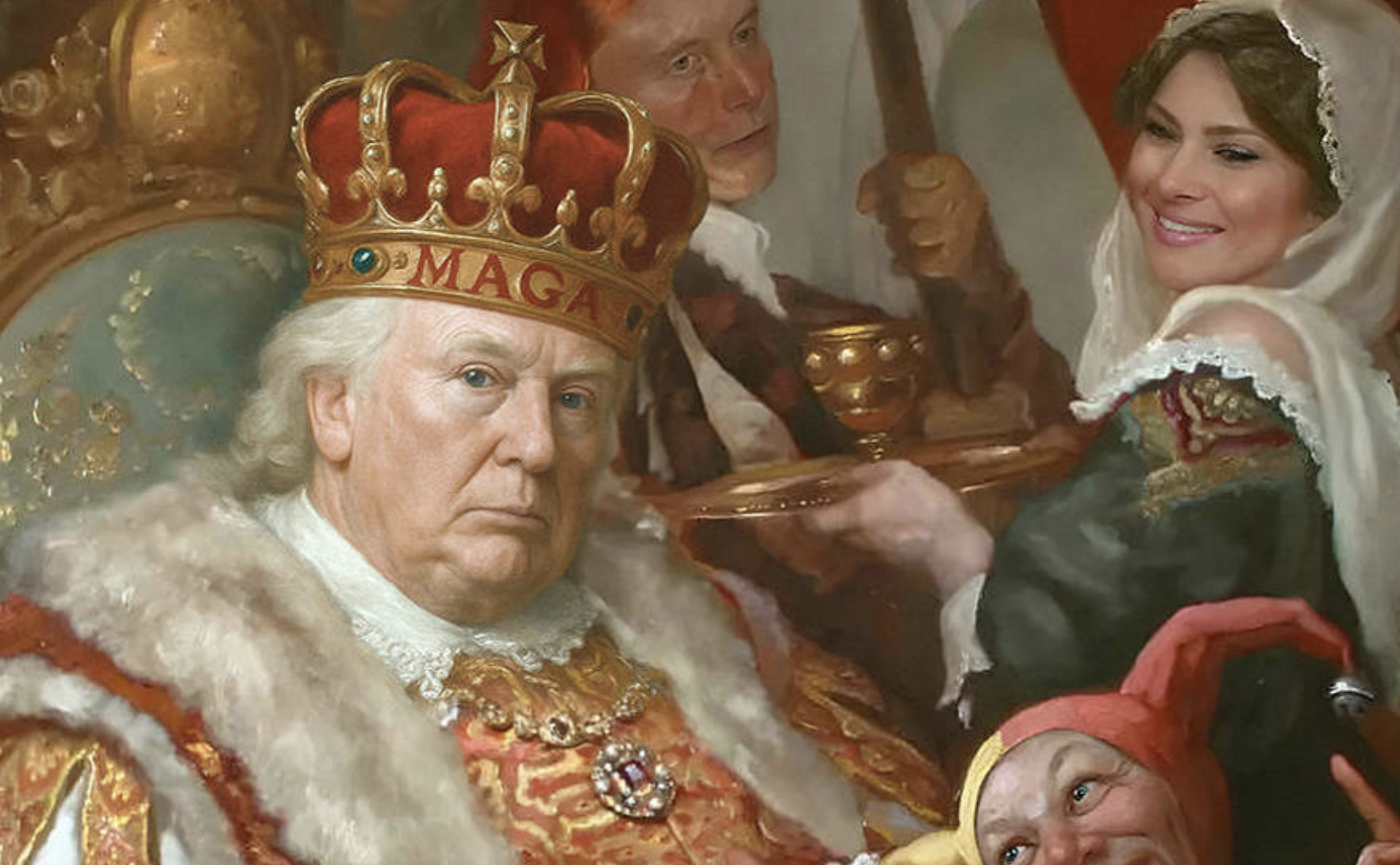
 

Artist's conception of Donald Trump in "King Trump vs. The Bond Market," by Kenneth Rogoff, in Project Syndicate, June 2, 2025.


President Donald Trump’s second-term executive agenda—based on public statements, policy actions, Executive/administrative orders, and aligned legislative efforts—revolves around a set of core themes that emphasize executive power, national sovereignty, economic nationalism, and a rollback of liberal democratic norms. These components appear to aim at consolidating presidential authority, remaking the federal bureaucracy in his image, and reshaping US governance and international posture according to his ideological framework.

Principal Components of Trump’s Executive Agenda (Second Term)

1. Expansion of Presidential Power

  • Emphasis on “unitary executive” theory: Trump and his legal advisors argue for nearly unchecked presidential control over the executive branch.

  • Claims of immunity: He asserts legal immunity from prosecution for actions taken while in office, with the Supreme Court taking up these questions.

  • Defiance of checks and balances: Trump has shown a willingness to ignore judicial rulings and marginalize congressional oversight, particularly regarding subpoenas, budget authority, and the administrative state.

2. Control and Purge of the Federal Bureaucracy

  • Reinstatement of Schedule F: Reclassifying civil service employees to allow for their dismissal and replacement with ideological loyalists.

  • Loyalty tests: Efforts to ensure government employees align with Trump’s agenda, including investigations into “deep state” influence.

  • Curtailment of independent agencies: Moves to bring agencies like the Department of Justice and the Federal Reserve under tighter presidential control.

3. Hardline Immigration and Border Policies

  • Mass deportations: Plans for large-scale removal of undocumented immigrants, including use of the National Guard.

  • Use of military for domestic enforcement: Expanding the role of federal and even military forces in policing the border and urban protests.

  • Asylum system rollback: Policies to deny or severely restrict refugee and asylum claims.

4. Retrenchment from International Institutions and Alliances

  • Threats to withdraw from NATO: Continuing efforts to reduce US commitments to collective defense structures.

  • America First foreign policy: Prioritizing bilateral deals over multilateral frameworks; reducing U.S. foreign aid and engagement.

  • Appeasement or realignment with authoritarian leaders: Favorable posture toward leaders like Putin and Orbán.

5. Rollback of Environmental and Regulatory Protections

  • Elimination of climate regulations: Withdrawal from international climate commitments and dismantling EPA authority.

  • Deregulation: Broad dismantling of financial, environmental, labor, and consumer protections under the guise of economic growth.

6. Weaponization of Federal Agencies Against Political Opponents

  • Justice Department investigations: Politicized investigations into Trump’s critics and adversaries.

  • Use of IRS, DHS, and other agencies: Allegations of using federal power to intimidate or punish perceived enemies.

7. Curtailment of Voting Rights and Electoral Oversight

  • Restricting mail-in and early voting: Advocating for measures that limit access to the ballot.

  • Challenging electoral legitimacy: Continued refusal to accept past results and groundwork to undermine future electoral outcomes.

8.  Delegitimizing and Defunding Higher Education Institutions*

  • Suppress Dissent and Intellectual Independence:
  1. Universities have historically been sources of resistance to authoritarianism, offering platforms for critical thinking, research, protest, and investigative journalism.
  2. Weakening these institutions undermines a major check on government overreach and narrows the space for ideological pluralism.
  • Undermine Meritocratic Elites and Reshape the Knowledge Economy:
  1. Trump’s broader populist narrative hinges on attacking “elites” and replacing professional expertise with loyalty and ideology.
  2. By degrading the authority of academic institutions, Trump delegitimizes the scientific, legal, and journalistic communities that challenge his claims.
  • Cultural engineering:
  1. The university is one of the last bastions of multiculturalism, globalism, and critical inquiry—all targets of the “America First” worldview.
  2. Attacks on DEI programs, gender studies, climate science, and global partnerships aim to reorient education toward a narrow, state-aligned ideology.
  • Appeal to Authoritarian Voters:
  1. For Trump’s base, especially white evangelical and ultranationalist voters, these attacks resonate deeply as a defense of “traditional values” against cosmopolitanism and liberal secularism.
  2. It’s not just about policy—it’s a symbolic assault on a class and culture they resent.
_________________________
*Like attacks on the press or the judiciary, these efforts to control or silence universities follow a familiar pattern from autocratic regimes—think of Hungary under Orbán, or Turkey under Erdoğan—where academic independence is crushed as a threat to national unity.

Overall Objective: Autocratic Executive Realignment

These components point toward a systematic restructuring of American governance to concentrate power in the executive branch, erode democratic guardrails, and transform the presidency into a more authoritarian institution. The assault on higher education complements his attacks on the judiciary, media, civil service, and voting systems—each a pillar of a constitutional democracy that resists authoritarian consolidation.
 
This is often framed by Trump and his allies as a restoration of American greatness and sovereignty, but operationally it resembles an effort to:
  • Undermine institutional checks on the presidency (courts, Congress, civil service, education)

  • Reorient loyalty from the Constitution to the president personally ("Re-educate" the populace)

  • Reinforce a nationalist-populist ideology hostile to globalism, immigration, and pluralism

  • Secure long-term political dominance by altering the administrative and electoral infrastructure

In essence, Trump’s agenda aims not just to govern differently, but to change the nature of governance itself, shifting the US toward an executive-centered regime with fewer constraints, less transparency, and a more exclusionary vision of national identity.


Monday, November 7, 2022

The Democratic Party: Internecine warfare is the deadliest

By Jon Phillips

Jon reacts to the November 4, 2022, opinion piece by Colbert I. King in the Washington Post regarding the Democratic Party under the Biden Presidency; "Internecine warfare is the deadliest."

Liz Cheney
Look at what a decade of party fratricide has done to the GOP. Half are supporting nutters and the nutty margin is growing as the MAGA fascists try to retire the remaining establishment Republicans, now clearly labeled as “RINOs” and traitors by today’s version of fanatical jackboot lickers who serve Trump’s agenda from one chaotic moment to the next. They used to be John Birchers, etc. Trump MAGAngsters are the new incarnation of right wing whack job in America.
 
What do we end up with if the Democrats also self destruct under pressure to move to their lunatic left wing fringe? Radical authoritarian right at war with radical peace loving progressive liberals? No — that’s not what happens. Progressive liberals will not survive a political wartime climate. Typically, only dictatorial types survive that environment.
Joe Manchin
It’s a race that gets meaner and more vicious in each cycle. The “nice” people just don’t make it. The progressive liberals would eventually be replaced by a radical authoritarian left either because they get forcibly retired as “LINOs” or because they learn to be vicious and unload their moral qualms to stay in position. That’s how it goes. It’s an ideological arms race that increasingly rewards brutality and punishes those who try to be ethical and fair.
 
Eventually those “snow flakes” are all melted away and horrible people are in power. By horrible, I don’t mean feisty politicians, I don’t mean typical politicians who’re painted by right wing fantasies like Q and Pizzagate to dehumanize them (look at the nonsense spread in Brazil’s recent election aimed at each side — it went all the way to cannibalism). I mean Hitler vs Stalin (and somewhat less vicious examples) as a psychopathic reality. Hitler and Stalin are sort of the most distilled examples in history of brutal right and left. People who murder many millions to serve the interest of their power.
 
Look at Central and South America. They’ve been stuck in that quagmire for many decades. Right wing authoritarians or left wing authoritarians. Periodic pseudo or full up brutal dictatorships. Occasional periods of decent government. Political violence and civil insurrection
 
That’s the logic of those who suppose that having a singular “correct” ideology is the way forward. A march toward extremes until, in terms of civil rights, both sides are brutal and indistinguishable when it comes to persecution of their political adversaries. As practical matter, both sides are the devil and use similar methods of coercion and brutality.
 
Democracy thrives best under centrist left and right parties. Why this is true is rather obvious. Centrists can work together and pass legislation that lasts and creates stability since the center is, by definition, where most of the people live on average. They’re capable of tolerating differences
 
But when you increasingly flip flop between far right and far left wing ideology, you tear stuff down. Institutional things that were very difficult to build. You try to build up and then dismantle over and over again and government loses public credibility against the tsunami of hateful lies “flooding the zone” — eventually from both sides. Eventually the center cannot hold and democracy recedes.
Donald Trump, September 6, 2016
 The only way to stably have radical government is under brutal authoritarians. People who physically crush and persecute their political opposition. They literally purge their opponents. Many Americans seem to suppose that is what they want these days — a strong man. Either a right winger or a left winger who will restore a singular order. The purpose being the elimination of significant ideological difference. That is not a nice place to be. It’s purely a fantasy that it might be better. The large majority will eventually suffer under it.
 
We’ve been stable for a long time and I suppose that Americans have no real idea how horrid things can get and how ruined a country can become and how quickly. Most of them have no relevant experience unless they grew up in a ghetto somewhere or fled some authoritarian country and migrated here. American voters don’t often know what very deep poverty is about in a personal sense. They’re not well “traveled”. When they leave the US, they go on vacation. Sometimes I hear them say how awful it was to see real poverty — but frankly at a distance.
 
They don’t go on vacation to see how the impoverished of the world live under chaotic and often authoritarian governments. Why would they go somewhere and risk getting dysentery or risk succumbing to violence or crime? Or just finding it too uncomfortable either physically or emotionally. Out of sight, out of mind. If they visit the developing world, they often go to some fancy resort with security guards. I’ve done that a few times. Relaxing on vacation is important, but often not very educational about the world.
 
But I’ve also spent much more time working overseas and been there for considerable time when not on holiday. I’ve been chewed on by vermin in a flea bag hotel and had dysentery. I’ve even had my life threatened a couple times. That’s where a large part of the world lives everyday. The main difference between the developed and developing world is the quality and history of governance institutions and their stability.
 
Sound and effective government institutions are very difficult to build. If you tear them down, everything else good eventually follows them in that collapse. Then we all live in the ruins and the ruins are most often governed by “King Rats,” not by “fair and just people.” Let’s not fool ourselves, and ruin ourselves.